The short answer
Professional AI video marketing for brands uses artificial intelligence to speed up selected parts of production while people remain responsible for the message, visual direction, accuracy and final quality. A strong design agency AI video marketing service does not sell random generated clips. It builds a repeatable system that turns business goals, product information and brand rules into videos made for real audiences.
Why brands are looking at AI video now
Video is no longer a special campaign format used twice a year. It appears on product pages, social feeds, sales presentations, digital billboards, training screens and messaging apps. A supermarket may need to show new arrivals every week. A delivery app may need several short demonstrations. A product company may need one version for TikTok, another for Instagram and a clearer explanation for its website.
The demand is high, but traditional production can be slow. Every new video may require a concept, script, location, products, people, lighting, filming, editing and several approval rounds. That process remains valuable when real people, real places or detailed demonstrations matter. But it is not the only method available.
AI changes the production equation. It can help teams explore scenes before filming, animate still product images, build variations, remove backgrounds, generate supporting shots, translate a voice-over, resize a campaign and test several openings. This makes frequent video more realistic for smaller teams.
The market data explains the interest. Wyzowl’s 2026 survey reports that 91% of businesses use video as a marketing tool and 93% of video marketers consider it important to their strategy. HubSpot’s 2026 State of Marketing says 80% of marketers use AI for content creation and 75% use it for media production. AI video is therefore not a distant experiment. It is already becoming part of normal marketing work.
What “professional AI video” actually means
A generated image that moves is not automatically a professional AI video. “Professional” describes the decisions around the tool, not the tool itself. The video must be accurate, easy to understand, consistent with the brand and suitable for the platform where it will appear.
A professional result usually passes five tests:
- The product stays truthful. Its shape, color, packaging and important features are not changed by generation errors.
- The message has one job. The viewer should know whether the video is introducing, explaining, proving or selling something.
- The visual identity is controlled. Colors, typography, framing, pacing and tone feel like the same brand from one video to the next.
- The format fits the channel. A vertical ten-second hook and a horizontal website explainer cannot be treated as the same file.
- The final video is reviewed by a person. Someone checks facts, spelling, strange movement, rights, audio and brand consistency before publication.
This is why the best result often comes from a hybrid workflow. Real product photography can protect accuracy. Design can organize the frame. AI can create motion, variations or environments. Editing can control the story. Human review decides what is good enough to represent the business.
The five layers of a professional result
AI accelerates production, but strategy and quality control still hold the system together.
What a design agency brings to AI video marketing
Anyone can open an AI tool and type a prompt. A design agency should bring what the prompt cannot: a point of view, a production method and responsibility for the result.
1. A clear brief before generation
The agency should ask about the audience, offer, problem, proof, desired action and platform. “Create a beautiful product video” is not enough. A useful brief sounds more like: “Show busy parents that this food product makes breakfast faster, in a 12-second vertical video that ends with the package clearly visible.” That sentence guides the story and gives the team something concrete to evaluate.
2. A visual system, not a different style every day
AI can produce endless styles. That freedom becomes a weakness when a brand looks luxurious on Monday, cartoonish on Wednesday and futuristic on Friday. A design agency defines a stable world: approved colors, product angles, lighting, backgrounds, motion, transitions, voice and graphic elements. Variation happens inside that system.
3. Product protection
Generative tools may bend a label, invent a cap or change the number of objects. These mistakes can make a video unusable or misleading. Professional production starts with good product references and identifies what must never change. When exact accuracy is critical, the product can remain photographic while AI is used around it.
4. Editing and finishing
Generation creates material. Editing creates the video. The agency selects shots, fixes rhythm, adds sound, places the call to action and removes anything that distracts from the message. It also prepares clean exports for each platform instead of stretching one master file into every shape.
5. A learning loop
The first month is not the end. A professional team compares hooks, subjects, watch time, clicks, saves, questions and sales signals. The next group of videos uses what the audience has revealed. AI helps produce more options, while results help the team choose better options.
Where AI helps—and where it should not take control
AI is useful when it removes repetitive work or makes an idea possible within the available time. It is less useful when the business needs direct proof of reality.
- Concept frames and storyboards
- Product-photo animation
- Background and scene variations
- 2D explainer sequences
- Subtitles, resizing and localization
- Multiple hooks from one campaign
- A customer testimony must be authentic
- A process must be demonstrated exactly
- A real location builds trust
- A founder’s personality is the message
- Legal or medical details require precision
- The product must be shown from every angle
The choice is not “AI or humans.” The better question is: which parts require reality, which require design and which can be accelerated safely?
Examples of AI video marketing for different brands
A supermarket
The supermarket provides clean photos of ten promoted products. The agency creates a consistent animated environment, then produces short videos for new arrivals, meal combinations and weekly offers. Real prices and packages remain exact. AI supplies movement and settings, while the marketing team controls the commercial facts.
A cosmetics brand
One product can appear in a clean studio sequence, an ingredient explainer and a simple routine video. AI can help create transitions and supporting scenes, but it should not invent impossible skin results. Claims, before-and-after images and testimonials require careful proof.
A delivery application
The app can combine real screen recordings with an animated problem-and-solution story. One video shows how to place an order. Another answers a concern about delivery time. A third introduces partner restaurants. The same design system makes the series recognizable.
A furniture seller
A clean cutout of a chair can be placed in several believable room styles to help customers imagine it at home. The dimensions and product structure must stay accurate. A final card can direct viewers to request the price, available fabrics or delivery details.
How to build a monthly AI video system
Random production creates random results. A monthly system begins with the questions customers ask and the commercial priorities of the business.
For a plan of 20 videos, that could mean five discovery videos, six explainers, five proof videos and four offers. The mix prevents a page from becoming a wall of advertisements. It also gives viewers different ways to enter the brand: through curiosity, a problem, a demonstration or a timely offer.
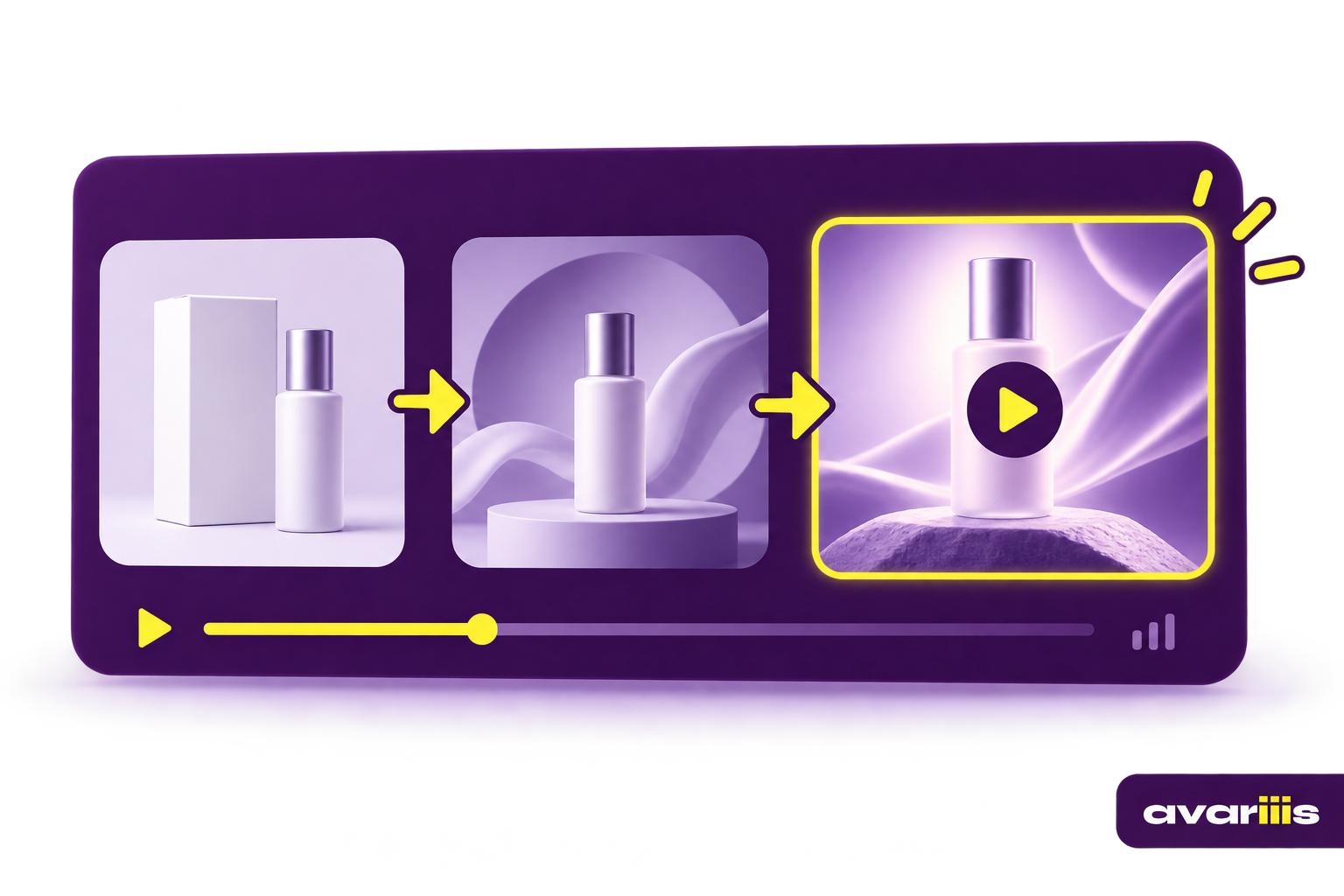
Start with a content bank. List products, customer questions, objections, use cases, seasonal moments and proof. Then turn one subject into several angles. A bottle is not one video. It can become a reveal, a use demonstration, an ingredient explanation, a comparison, a customer question and a short offer.
HubSpot reports that short-form video leads the content formats marketers associate with ROI, at 49%, ahead of long-form video and live streaming. That does not mean every video must be short. It means short video deserves a clear role in the system. Longer explanations can live on YouTube or a website, while short versions create discovery on social platforms.
How to judge a design agency AI video marketing offer
Before choosing a provider, ask questions that reveal the process behind the samples:
- How will the team learn our products, customers and brand rules?
- Which parts will use AI, photography, design, animation or traditional editing?
- How will product details remain accurate?
- How many concepts, videos, formats and correction rounds are included?
- Who checks facts, spelling, rights and platform requirements?
- Will we receive a monthly content plan or only finished files?
- How will the team measure what should be repeated or improved?
- Can the same visual system scale to future campaigns?
Do not judge only by how cinematic one sample looks. A strong partner must also produce consistently, respect deadlines, understand the offer and create files that the business can actually publish.
Trust, disclosure and responsible use
Professional AI video for brands should never depend on deception. Do not fabricate customer testimonies, copy a real person’s face or voice without permission, or show a product performing something it cannot do. Keep records of the approved claims and source assets used in production.
Platforms also have rules. YouTube explains that creators must disclose realistic content that was meaningfully altered or generated with AI. The platform may apply a label when its systems detect undisclosed AI use. Other platforms and local rules can differ, so the publishing team should check current requirements before each campaign.
Transparency does not make creative work weaker. It protects trust. A stylized product animation can be openly creative. A realistic fake testimony is something else entirely.
Will AI make every brand look the same?
It can—when every business uses the same prompts, voices, transitions and generic claims. HubSpot’s 2026 report describes AI as a baseline rather than a differentiator. In other words, using AI is no longer the special part. The advantage comes from the quality of the idea, the specificity of the brand and the discipline of the system.
A professional agency should therefore protect the details that competitors cannot copy easily: real customer knowledge, local context, product truth, tone, opinions, service experience and a recognizable visual language. AI increases production capacity. Brand strategy gives that capacity a direction.
A practical first project
Begin with one product or service and one customer question. Create three short concepts: one that attracts attention, one that explains and one that proves. Keep the product references identical. Change only the opening, story or environment. Publish the videos in suitable formats and compare watch time, saves, clicks and qualified messages.
This small test is more useful than generating 50 unrelated clips. It shows how the team handles accuracy, brand consistency and feedback. If the system works, expand it into a monthly library.
Final takeaway
AI is not a replacement for marketing judgment. It is a production advantage when a team knows what to say, what to protect and what the viewer should do next. The right design agency uses AI to reduce friction, explore more ideas and create useful variations—without handing the brand over to automation.
If your business needs regular product videos, explainers or social content, start with a clear system. Define the audience, organize the messages, protect the product and build a visual language that can grow. That is what makes AI video marketing professional.
Sources
- Wyzowl — Video Marketing Statistics 2026
- HubSpot — 2026 State of Marketing Report
- HubSpot — 2026 Marketing Statistics
- YouTube — How Creators Use AI for Content Creation
Survey findings describe broader trends and do not guarantee the results of an individual campaign.